
Caisson d'artillerie
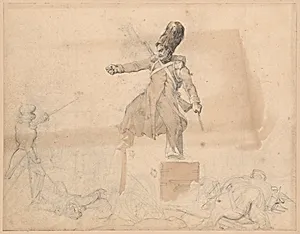
Medium
Graphite on ivory wove paper
Dimensions
22.1 × 28.5 cm (8 3/4 × 11 1/4 in.)
Classification
graphite
Department
Prints and Drawings
Museum
Art Institute of Chicago
Accession Number
128096
Rights
Public Domain
Art Historical Context
Created in 1818 by Théodore Géricault, one of the leading figures of French Romanticism, *Caisson d’artillerie* captures a moment of military life with quiet intensity. Just a before he unveiled his monumental *Raft of the Medusa*, Géricault turned his attention to the aftermath of the Napoleonic Wars, recording the everyday equipment and animals that had shaped recent history. The drawing’s modest size—barely larger than a sheet of notebook paper—belies the energy contained within its lines. Working in graphite on smooth ivory wove paper, Géricault demonstrates his celebrated draftsmanship. Fine hatching and confident contours describe the heavy wooden caisson and the powerful horses that pulled, revealing his lifelong fascination with equine anatomy and movement. Such studies allowed him to explore dramatic contrasts of light and shadow while preparing for larger paintings. Today housed in the Art Institute of Chicago’s Prints and Drawings department, this work offers visitors a glimpse into the artist’s working process. It reminds us that even the grandest Romantic canvases began with careful, observant sketches made from life.
About the Artist
Jean Louis André Théodore Géricault · 1791–1824
Jean-Louis André Théodore Géricault (1791–1824) was born into a prosperous bourgeois family in Rouen, France, the son of a lawyer who managed the family tobacco business. After moving to Paris around 1797, his artistic talent emerged early, nurtured in a circle that included his maternal uncle Jean-Baptiste Caruel and art dealer Jean-Louis Laneuville. Géricault began formal training in 1808 under ...