
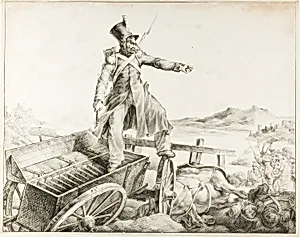
The Artillery Caisson
Medium
Lithograph in black on ivory wove paper
Dimensions
Image: 41.5 × 52.4 cm (16 3/8 × 20 11/16 in.); Sheet: 42 × 53.7 cm (16 9/16 × 21 3/16 in.)
Classification
lithograph
Department
Prints and Drawings
Museum
Art Institute of Chicago
Accession Number
14456
Rights
Public Domain
Art Historical Context
**The Artillery Caisson** (1818) is a striking lithograph by Théodoreéricault, the French Romantic artist renowned for his dramatic depictions of human struggle and equine power. Created when Géricault was just 27, this work captures a moment of military might: a caisson—a two-wheeled cart carrying artillery ammunition—pulled by powerful horses amid a team of soldiers. Printed in bold black ink on ivory wove paper (image: 41.5 × 52.4 cm), it exemplifies the raw energy of Romanticism, with Géricault's masterful rendering of motion and tension foreshadowing his masterpiece, *The Raft of the Medusa* (1819). Lithography, a revolutionary printing technique invented just two decades earlier, allowed Géricault to draw directly on stone, achieving unprecedented fluidity and detail in mass reproduction. This piece belongs to his rare series of seven military lithographs from 1818, produced during the post-Napoleonic era when France grappled with its imperial legacy. Housed in the Art Institute of Chicago's Prints and Drawings Department, it highlights lithography's role in democratizing art, making Géricault's visceral style accessible beyond oil paintings. Visitors will appreciate how *The Artillery Caisson* conveys the chaos and heroism of warfare through dynamic composition—horses straining forward, figures in urgent motion—inviting reflection on 19th-century Europe's turbulent history. A testament to Géricault's innovative spirit, it remains a gem for print enthusiasts.
About the Artist
Jean Louis André Théodore Géricault · 1791–1824
Jean-Louis André Théodore Géricault (1791–1824) was born into a prosperous bourgeois family in Rouen, France, the son of a lawyer who managed the family tobacco business. After moving to Paris around 1797, his artistic talent emerged early, nurtured in a circle that included his maternal uncle Jean-Baptiste Caruel and art dealer Jean-Louis Laneuville. Géricault began formal training in 1808 under ...