
Study for Caisson d'artillerie
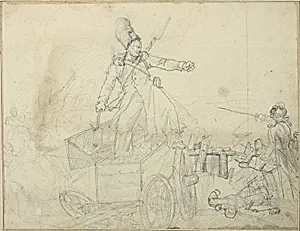
Medium
Graphite with brown ink wash on ivory wove paper
Dimensions
22.2 × 28.5 cm (8 3/4 × 11 1/4 in.)
Classification
graphite
Department
Prints and Drawings
Museum
Art Institute of Chicago
Accession Number
128097
Rights
Public Domain
Art Historical Context
In 1818, French Romantic artist Théodore Géricault created *Study for Caisson dillerie*, a preparatory drawing captures his fascination with dynamic motion and military subjects. Géricault, known for his monumental *Raft of the Medusa* (1819), often sketched horses in powerful, realistic poses, reflecting the Romantic era's emphasis on emotion, nature's raw energy, and human struggle. This work likely served as a study for a larger composition depicting an artillery caisson—a horse-drawn wagon for transporting cannon ammunition—evoking the chaos and heroism of Napoleonic warfare, which lingered in French cultural memory. Executed on ivory wove paper with graphite and brown ink wash, the 22.2 × 28.5 cm sheet showcases Géricault's virtuoso draftsmanship. Graphite provides precise lines for anatomical detail, while the ink wash adds volumetric depth and dramatic chiaroscuro, heightening the sense of movement and tension. Such techniques were innovative for studies, bridging preparatory work and finished art, and highlight Géricault's training under Carle Vernet, a master of equine depiction. Housed in the Art Institute of Chicago's Prints and Drawings Department, this intimate drawing reveals the meticulous process behind Géricault's bold paintings, offering visitors a glimpse into the Romantic artist's relentless pursuit of vitality on paper.
About the Artist
Jean Louis André Théodore Géricault · 1791–1824
Jean-Louis André Théodore Géricault (1791–1824) was born into a prosperous bourgeois family in Rouen, France, the son of a lawyer who managed the family tobacco business. After moving to Paris around 1797, his artistic talent emerged early, nurtured in a circle that included his maternal uncle Jean-Baptiste Caruel and art dealer Jean-Louis Laneuville. Géricault began formal training in 1808 under ...