
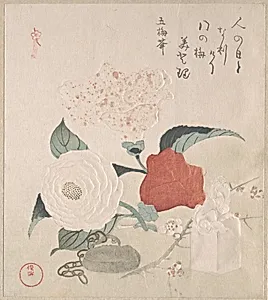
Camellia Flowers, a Netsuke and a Seal
19th century
Medium
Part of an album of woodblock prints (surimono); ink and color on paper
Dimensions
8 3/8 x 7 3/8 in. (21.3 x 18.7 cm)
Classification
Prints
Culture
Japan
Department
Asian Art
Museum
Metropolitan Museum of Art, New York, NY
Credit
H. O. Havemeyer Collection, Bequest of Mrs. H. O. Havemeyer, 1929
Accession Number
JP2305
Rights
Public Domain
Tags
Art Historical Context
Behold the delicate beauty of *Camellia Flowers, a Nets and a Seal* by Kubo Shunman, a masterful 19th-century Japanese woodblock print from a *surimono* album. Created during Japan's Edo period, *surimono* were commissioned prints, often for New Year's greetings or poetry circles, showcasing exceptional craftsmanship with vibrant inks, subtle colors, and sometimes metallic accents on fine paper. Shunman, a prominent ukiyo-e artist for his poetic still lifes, captures everyday elegance in this intimate 8 3/8 x 7 3/8-inch sheet. At the heart of the composition bloom vivid camellia flowers, symbols of fleeting beauty and winter resilience in Japanese culture, arranged alongside a intricately carved netsuke—a tiny toggle for securing pouches to kimono sashes—and a personal seal. The meticulous woodblock technique allows for precise layering of colors and textures, evoking a sense of refined domesticity. This piece, part of the H.O. Havemeyer Collection at the Metropolitan Museum of Art, highlights the fusion of art and utility in Edo-era Japan, where such prints celebrated nature's transience and artisanal skill. Today, it invites visitors to appreciate the quiet poetry of ordinary objects, bridging centuries with its timeless charm.
About the Artist
Kubo Shunman · 1757–1820
Japanese, 1757–1820