
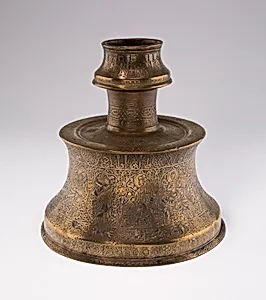
Candlestick (Sham'dan) with Scenes of Monthly Labors
13th century
Medium
Brass with engraved decoration and inlaid silver
Dimensions
19.8 × 19.6 × 19.4 cm (7 13/16 × 7 11/16 × 7 5/8 in.)
Classification
candleholder - candlestick
Department
Arts of Asia
Museum
Art Institute of Chicago
Accession Number
21037
Rights
Public Domain
Art Historical Context
This exquisite 13th-century Islamiclestick, or *sham'dan*, stands as a testament to the refined metalworking traditions of the medieval Islamic world. Crafted brass and adorned with engraved decoration inlaid with silver, it measures a compact 19.8 × 19.6 × 19.4 cm, perfect for illuminating, mosques, or palaces. The object's functional beauty highlights the era's mastery in blending utility with artistry, where everyday items became canvases for storytelling. The surface features intricate scenes of monthly labors—depictions of agricultural and seasonal activities that cycle through the year—engraved into the brass and filled with shimmering silver inlays. This *damascening* technique, involving precise chasing and inlaying, creates dynamic contrasts of light and texture, making the candlestick gleam as flames danced nearby. Such figural motifs, common on secular metalwork, reflect the vibrant daily life of Islamic societies, possibly drawing from calendar traditions or zodiac influences adapted to local customs. Housed in the Art Institute of Chicago's Arts of Asia department, this *sham'dan* exemplifies the 13th century's golden age of Islamic decorative arts, particularly in regions like Syria or Egypt under Ayyubid or early Mamluk patronage. It invites visitors to appreciate how artisans transformed humble brass into a luminous chronicle of human endeavor and craftsmanship.
About the Artist
Islamic
Islamic art, a profound visual tradition originating in the 7th century CE, flourished across vast territories from Spain to India under Muslim rule, encompassing architecture, ceramics, manuscripts, textiles, and metalwork produced by diverse artisans rather than a single named master. Drawing from pre-Islamic Sasanian, Byzantine, and late antique influences, its early development under the Umayy...