
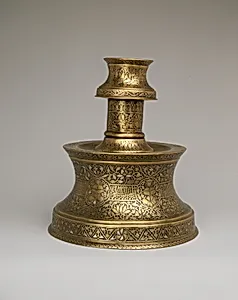
Candlestick with Repeating Seated Figure, Inscription, and Flowers
Unknown Artist
second half 14th century
Medium
Brass; cast, engraved, and originally inlaid with silver
Dimensions
H. 9 1/2 in. (24.1 cm) Diam. 8 1/2 in. (21.6 cm)
Classification
Metal
Department
Islamic Art
Museum
Metropolitan Museum of Art, New York, NY
Credit
Edward C. Moore Collection, Bequest of Edward C. Moore, 1891
Accession Number
91.1.584
Rights
Public Domain
Art Historical Context
This exquisite brass candlestick, crafted in the second half of the 14 century, exemplifies the pinnacle of Islamic metalworking artistry. Standing at 9 1/2 inches tall with an 8 1/2-inch diameter base, it features a repeating figure, elegant floral motifs, and inscriptions—hallmarks of decorative sophistication from the Mamluk era in Egypt or Syria. Originally inlaid with silver, the piece would have shimmered with luxurious contrast, transforming a functional household item into a symbol refined taste and piety. The candlestick was created through skilled casting, followed by intricate engraving and silver inlay, a technique known as *tafsir* or damascening. This labor-intensive process allowed artisans to embed fine silver wire into incised brass, highlighting motifs that often drew from nature, courtly life, and Qur'anic verses. Such objects were prized in wealthy Islamic households and mosques, blending utility with spiritual symbolism—light from the candle evoking divine illumination. Acquired as part of the Edward C. Moore Collection and now in the Metropolitan Museum of Art's Islamic Art department, this anonymous masterpiece reveals the technical virtuosity and cultural flourishing of the medieval Islamic world, where metalwork rivaled the finest ceramics and textiles.