
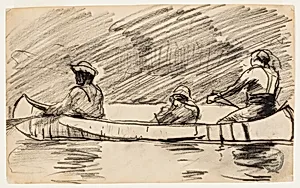
Canoe with Three Men
Medium
landscapes
Classification
landscapes
Department
Smithsonian Collection
Museum
Smithsonian American Art Museum
Credit
Gift of Charles Savage Homer, Jr.
Accession Number
1912-12-44
Rights
Public Domain
About this artwork
Research in Progress
Art Historical Context
Winslow Homer, one of America’s most celebrated 19th-century artists, created “Canoe with Three Men” in 1897, late in his career. Known for his realistic portrayals of nature and human endurance, Homer often turned to outdoor subjects that captured the quiet drama of wilderness life. This work, classified as a landscape and now part of the Smithsonian American Art Museum’s collection, reflects his enduring interest in scenes of water and exploration. The painting was gifted to the museum by the artist’s brother, Charles Savage Homer, Jr., ensuring its place among significant holdings of American art. Though research on the piece remains in progress, its title suggests a moment of camaraderie and movement through a natural setting, themes that resonated deeply with viewers during the nation’s rapid industrialization. Homer’s ability to convey both the beauty and the subtle tension of such environments helped define a distinctly American vision of the landscape. Visitors today can appreciate how the work connects personal experience with broader cultural ideas of adventure and the natural world at the turn of the twentieth century.