
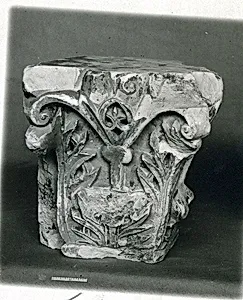
Capital with Acanthus Leaves
Unknown Artist
6th–7th century
Medium
Limestone; carved in relief
Dimensions
H. 11 3/8 in. (28.9 cm) W. 10 5/8 in. (27 cm) D. 10 5/8 in. (27 cm)
Classification
Sculpture
Department
Islamic Art
Museum
Metropolitan Museum of Art, New York, NY
Credit
Rogers Fund, 1910
Accession Number
10.175.40
Rights
Public Domain
Art Historical Context
Behold the **Capital with Acanthus Leaves a finely carved limestone architectural element from the 6–7th century, now gracing the Islamic Art department at The Metropolitan Museum of Art. This compact (H. 113/8 in., W 10 5/8 in., D. 10 5/8 in.) served as the crowning top of a column, its surface alive with intricate relief carvings of lush acanthus leaves—a motif rooted in ancient classical traditions yet vibrant in early Islamic artistry. Crafted in low-relief on durable limestone, the piece showcases masterful stoneworking techniques typical of the era, where artisans delicately balanced depth and shadow to evoke natural foliage. The acanthus, symbolizing eternal growth and resilience, bridges Greco-Roman influences with emerging Islamic aesthetics, which favored abstract vegetal patterns over figurative forms. Likely from a mosque, palace, or public structure in the early Islamic world—possibly Syria or Mesopotamia—this capital reflects cultural synthesis during a transformative period. Acquired through the Rogers Fund in 1910, it invites us to ponder the seamless evolution of decorative arts across civilizations, reminding visitors of architecture's power to harmonize heritage and innovation.