
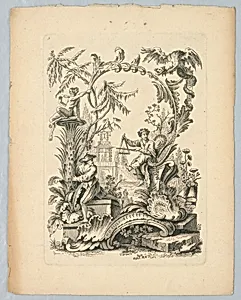
Cartouche with Chinoiserie Motifs
Classification
Department
Smithsonian Collection
Museum
Smithsonian American Art Museum
Credit
Gift of Eleanor and Sarah Hewitt
Accession Number
1931-94-661
Rights
Public Domain
About this artwork
Research in Progress
Art Historical Context
Created around 1740 by French artist Alexis Peyrotte, *Cartouche with Chinoiserie Motifs* captures the playful elegance of the Rococo period. Peyrotte, celebrated for his ornamental designs, embraced chinoiserie—a fashionable European interpretation of Chinese and East Asian aesthetics that featured delicate pagodas, exotic figures, and fanciful landscapes. This print likely served as a decorative template, its cartouche format providing an ornate frame that could be adapted for textiles, ceramics, or interior panels. During the reign of Louis XV, such designs reflected Europe’s growing fascination with global trade and imagined “Oriental” worlds, blending them with graceful asymmetry and lighthearted detail. As a work on paper from the Smithsonian’s collection, it offers insight into how prints helped spread new decorative trends across workshops and households. Donated by the Hewitt sisters, founders of what became Parsons School of Design, the piece also highlights the role of women collectors in preserving 18th-century design history.