
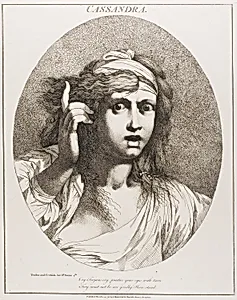
Cassandra, from Twelve Characters from Shakespeare
originally published March 15, 1776, published 1809
Medium
Etching on cream wove paper
Dimensions
Plate: 40 × 32.3 cm (15 3/4 × 12 3/4 in.); Sheet: 59.5 × 43.8 cm (23 7/16 × 17 1/4 in.)
Classification
etching
Department
Prints and Drawings
Museum
Art Institute of Chicago
Accession Number
155627
Rights
Public Domain
Art Historical Context
Behold *Cassandra, from Twelve Characters from Shakespeare*, a captivating etching by the British artist John Hamilton Mortimer1740–1779). Created as part of a series inspired by Shakespeare's dramatic personas, this print originally appeared in 1776 and was republished in 1809 reflecting enduring fascination with the Bard during the Romantic era. Mortimer, celebrated for his bold, expressive style bridging Rococo elegance and proto-Romantic intensity, drew from *Troilus and Cressida portraying the tragic prophetess Cassandra—doomed to foresee Troy's fall yet disbelieved by all. Rendered in etching on cream wove paper, the work showcases Mortimer's mastery of this intaglio technique, where acid etches intricate lines into a metal plate for rich, tonal depth and dramatic shading. The plate measures 40 × 32.3 cm, with the full sheet at 59.5 × 43.8 cm, allowing for generous margins that enhance its presence as a standalone print. Housed in the Art Institute of Chicago's Prints and Drawings department, it exemplifies 18th-century printmaking's role in democratizing high art, making Shakespearean tragedy accessible beyond oil paintings. This piece invites visitors to ponder Cassandra's anguish, a timeless emblem of ignored wisdom, through Mortimer's theatrical flair—perfect for evoking the era's passion for literature and emotion.
About the Artist
John Hamilton Mortimer · 1740–1779
Comment on works: History; Portraits; Genre