
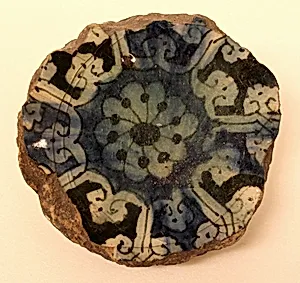
Ceramic Fragment
Unknown Artist
13th–16th century
Medium
Stonepaste; painted under transparent glaze
Dimensions
H. 1 1/8 in. (2.9 cm) W. 3 5/8 in. (9.2 cm) D. 3 5/8 in. (9.2 cm) Wt. 4.2 oz. (119.1 g)
Classification
Ceramics
Department
Islamic Art
Museum
Metropolitan Museum of Art, New York, NY
Credit
Gift of Jack A. Josephson, 1973
Accession Number
1973.79.6
Rights
Public Domain
Art Historical Context
This delicate ceramic fragment, dating from the 13th to 16th century, offers a glimpse into the refined world of Islamic pottery. Housed in the Metropolitan Museum of Art's Department of Islamic Art, it just 1 1/8 inches high and 3 5/8 inches wide and deep, likely originating from a larger vessel such as a tile, bowl, or dish. Gifted by Jack A. Josephson in1973, it exemplifies the enduring allure of these artifacts, which survived centuries to reach modern audiences. Crafted from stonepaste—a composite of quartz, clay, and frit developed by Islamic artisans—this fragment showcases a pivotal innovation in ceramics. Stonepaste allowed for thinner, more translucent bodies that rivaled imported Chinese porcelain, flourishing in regions like Syria, Egypt, and Iran during the Mamluk and Mongol-influenced eras. The underglaze painting, sealed beneath a transparent glaze, preserved vibrant colors and intricate designs against daily wear, highlighting masterful technical skill and aesthetic sophistication. Though incomplete, this piece whispers of the cultural crossroads of the medieval Islamic world, where artistry blended functionality with beauty. Visitors are invited to imagine its original vibrancy, a testament to anonymous craftsmen whose techniques influenced global ceramics for generations.