
Chalcedony rectangular prism
Unknown Artist
ca. 1750–1600 BCE
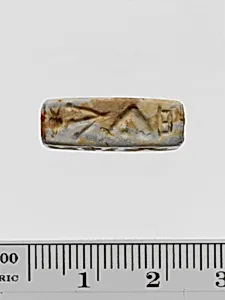
Medium
Chalcedony, burnt
Dimensions
L. 2 cm; W. 0.7 cm
Classification
Gems
Culture & Period
Minoan · Middle Minoan III
Department
Greek and Roman Art
Museum
Metropolitan Museum of Art, New York, NY
Credit
Bequest of Richard B. Seager, 1926
Accession Number
26.31.156
Rights
Public Domain
Tags
Art Historical Context
This exquisite chalcedony rectangular prism, dating to the Middle Minoan III periodca. 1750–1600 BCE), offers a glimpse into the sophisticated world of Minoan Crete. Carved from burnt chalcedony—a durable microcrystalline quartz variety heat-treated to achieve a rich, translucent hue—this tiny gem measures just 2 cm long and 0.7 cm wide. Likely used as a seal or stamp, its compact form highlights the Minoans' mastery of miniature craftsmanship, perfect for impressing designs into clay for administrative or ownership purposes. Adorned with intricate hieroglyphs, the prism bears symbols from one of Europe's earliest writing systems, Minoan hieroglyphic script, which remains largely undeciphered. Flourishing on Crete before the rise of Linear A, this script underscores the Minoans' advanced bureaucratic society, evident in grand palaces like Knossos. Such gems reveal a culture celebrated for vibrant frescoes, bull-leaping rituals, and maritime prowess, bridging the Bronze Age gap between Near Eastern and Aegean traditions. Bequeathed to the Metropolitan Museum of Art by Richard B. Seager in 1926, this artifact invites us to ponder the daily lives of Minoan elites, where even the smallest objects encoded power and identity. A testament to enduring mystery, it captivates with its blend of artistry and enigma.