
Steatite rectangular prism
Unknown Artist
ca. 1900–1750 BCE
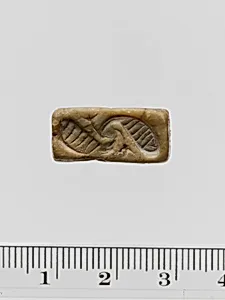
Medium
Serpentine
Dimensions
L. 1.9 cm; W. of each side 0.8 cm
Classification
Gems
Culture & Period
Minoan · Middle Minoan II
Department
Greek and Roman Art
Museum
Metropolitan Museum of Art, New York, NY
Credit
Bequest of Richard B. Seager, 1926
Accession Number
26.31.125
Rights
Public Domain
Tags
Art Historical Context
This diminutive steatite rectangular prism, carved smooth serpentine stone, hails from Minoan Crete during the Middle Minoan II period (ca. 1900–1750 BCE). Measuring just 1.9 cm long and 0.8 cm wide on each face, it exemplifies the exquisite miniature artistry of the Bronze Age Aegean civilization. As a gem or stamp seal, it would have been used to imprint clay for sealing documents, goods, or storage jars in the bustling palace economies of sites like Knossos or Phaistos. The prism's four sides feature finely incised motifs: figures of men, hieroglyphic signs—early precursors to the Minoan Linear A script—and stylized leaves, showcasing the culture's emerging symbolic language and naturalistic motifs. Carving such intricate details into soft steatite demanded remarkable precision, highlighting Minoan gem-cutters' mastery of micro-scale engraving techniques without metal tools. Bequeathed to the Metropolitan Museum of Art by archaeologist Richard B. Seager in 1926, this artifact offers a glimpse into Minoan administrative life and one of the earliest known writing systems in Europe, bridging art, bureaucracy, and ritual in a thriving prehistoric society.