
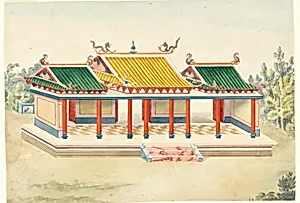
Chinoiserie Pavilion
Medium
architecture
Classification
architecture
Department
Smithsonian Collection
Museum
Smithsonian American Art Museum
Credit
Museum purchase through gift of Mrs. John Innes Kane
Accession Number
1948-40-80
Rights
Public Domain
About this artwork
Research in Progress
Art Historical Context
Step into the enchanting world of the *Chinoiserie Pavilion a masterful architectural creation by English designer Frederick Crace (1779–1859), crafted between 1815 and1822. Crace, part of a celebrated family of decorators who worked on royal projects like Buckingham Palace, specialized opulent interiors and exteriors. Chinoiserie, the European fascination with imagined Chinese motifs—pagodas, lattices, and asymmetrical elegance—reached its peak in the Regency era, blending Rococo whimsy with exotic allure amid Britain's growing trade with Asia. This pavilion exemplifies the style's cultural significance, serving as a garden retreat or folly for the elite, evoking distant empires through delicate tracery and vibrant ornamentation. Acquired by the Smithsonian American Art Museum through the generous gift of Mrs. John Innes Kane, it highlights transatlantic tastes, bridging British design innovation with American collections. Though research continues, its presence invites us to ponder how 19th-century imaginations transformed global influences into tangible dreams of paradise.