
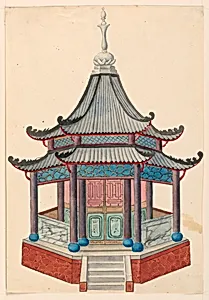
Design for a Chinese Pavilion
Classification
architecture
Department
Smithsonian Collection
Museum
Smithsonian American Art Museum
Credit
Museum purchase through gift of Mrs. John Innes Kane
Accession Number
1948-40-82
Rights
Public Domain
About this artwork
Research in Progress
Art Historical Context
**Design for a Chinese Pavilion** *Frederick Crace (English, 1779–1859), 1815–22* Frederick Crace, a prominent English decorator from a family renowned for lavish interiors, created this architectural design during the Regency era1815–22). As part of the Crace dynasty that supplied opulent schemes for royalty, including King George IV's Brighton Pavilion, Crace specialized in blending European elegance with exotic motifs. This work reflects the era's Chinoiserie craze—a fashionable European interpretation of Chinese aesthetics, featuring pagodas, latticework, and ornate details that evoked distant empires without strict historical accuracy. Classified as architecture and held in the Smithsonian American Art Museum (purchased through the gift of Mrs. John Innes Kane), the design captures the playful eclecticism of early 19th-century taste. Though the medium remains under research, it likely served as a blueprint for a garden pavilion or interior space, embodying how Britons romanticized the Orient amid growing trade with China. Crace's piece highlights architecture's role as cultural fantasy, bridging art and design in a time of imperial expansion. Visitors, imagine strolling through such a whimsical structure—its curves and colors a portal to imagined Eastern splendor right in an English estate! (178 words)