
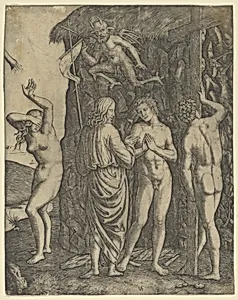
Christ in Limbo with Adam and Eve
ca. 1500–34
Medium
Engraving
Dimensions
8 7/16 x 6 3/4 in. (21.5 x 17.1 cm)
Classification
Prints
Department
Drawings and Prints
Museum
Metropolitan Museum of Art, New York, NY
Credit
The Elisha Whittelsey Collection, The Elisha Whittelsey Fund, 1949
Accession Number
49.97.14
Rights
Public Domain
Tags
Art Historical Context
In the early 16th century, artists Marcantonio Raimondi Francesco Francia collaborated on *Christ in Limbo with Adam Eve*, a striking engraving that captures a pivotal moment from Christian theology: the Harrowing of Hell Here, Christ descends into Limbo—the realm between Heaven and Hell—after his crucifixion, shattering the gates to liberate the souls of the righteous, symbolized by Adam and Eve, the first humans. This scene, rich with Renaissance drama, reflects the era's fascination with salvation history and the triumph of divine grace over original sin. Raimondi, a master engraver renowned for translating High Renaissance designs into prints, likely reproduced Francia's composition, a Bolognese painter known for his refined, devotional style. The engraving medium was revolutionary, allowing intricate details—like the cross, broken chains, and expressive figures—to be reproduced affordably, spreading sacred imagery to a wider audience beyond elite patrons. Measuring just 8 7/16 x 6 3/4 inches, its compact scale belies its emotional intensity. Housed in the Metropolitan Museum of Art's Drawings and Prints department, this work exemplifies the Italian Renaissance's blend of spiritual depth and technical innovation, inviting visitors to ponder humanity's redemption through art's enduring power.
About the Artist
Marcantonio Raimondi|Francesco Francia · 1475–1534
Marcantonio Raimondi (c. 1480–1534), born near Bologna, Italy, emerged as one of the Renaissance's premier engravers, revolutionizing printmaking through his mastery of reproductive techniques. He trained in the workshop of the goldsmith, painter, and niellist Francesco Francia, whose influence is evident in his early engravings, such as the goldsmith-like shading in *Pyramus and Thisbe* (1505), h...