
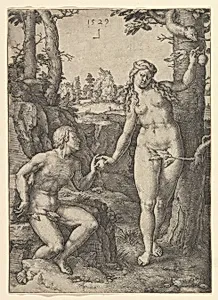
Fall of Man
1529
Medium
Engraving
Dimensions
sheet: 6 3/8 x 4 5/8 in. (16.2 x 11.7 cm)
Classification
Prints
Department
Drawings and Prints
Museum
Metropolitan Museum of Art, New York, NY
Credit
Gift of Mrs. Charles Pratt, 1957
Accession Number
57.531.12
Rights
Public Domain
Tags
Art Historical Context
Lucas van Leyden's *Fall of Man* (1529) is a masterful engraving capturing the biblical moment of Adam and Eve's expulsion from Eden, rendered with striking nudity that emphasizes human vulnerability and original sin. Created late in the artist's short life—he died at just 39—this small-scale print (6 3/8 x 4 5/8 in.) showcases van Leyden's Northern Renaissance prowess, blending intricate line work with dramatic composition. As a leading Dutch engraver influenced by Albrecht Dürer, he elevated printmaking to rival painting in detail and expressiveness. Engravings like this were revolutionary for their reproducibility, allowing widespread dissemination of complex narratives during the Reformation era, when religious imagery faced scrutiny. Van Leyden's precise burin technique produces fine textures—from Eve's flowing hair to the dense foliage—creating depth in a modest format. The bold male and female nudes reflect Renaissance humanism's fascination with the body, yet rooted in moral allegory. Today, this gem graces the Metropolitan Museum of Art's Drawings and Prints department, a 1957 gift that highlights its enduring appeal. Visitors marvel at how van Leyden packs profound theological drama into an intimate sheet, inviting reflection on humanity's timeless fall.
About the Artist
Lucas van Leyden · 1484–1533
Lucas van Leyden (1494–1533) was a Dutch painter and printmaker who stands among the greatest engravers of the Northern Renaissance. Born in Leiden as either Lucas Hugensz or Lucas Jacobsz, he lived and worked primarily in his native city, achieving international renown that rivaled the German master Albrecht Dürer. Lucas van Leyden revolutionized Netherlandish printmaking and was among the first...