
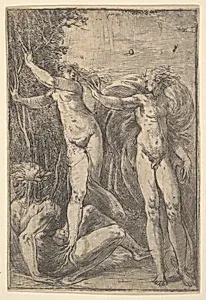
Apollo and Daphne
ca. 1538–40
Medium
Etching
Dimensions
sheet: 5 3/4 x 3 7/8 in. (14.6 x 9.9 cm)
Classification
Prints
Department
Drawings and Prints
Museum
Metropolitan Museum of Art, New York, NY
Credit
Harris Brisbane Dick Fund, 1926
Accession Number
26.70.3(195)
Rights
Public Domain
Tags
Art Historical Context
Behold *Apollo and Daphne*, a etching by the Venetian artist Andrea Schiavone ( Meldola), created around 1538–40. This small yet dynamic print (5 3/4 x 3 7/8 in.) captures dramatic moment from Ovid's *Metamorphoses*, where god Apollo pursues the nymph Daphne, who transforms into a laurel to evade his love. Schiavone, a key figure in 16th-century Venetian art, drew inspiration from masters like Titian and Parmino, blending Renaissance grace with emerging Mannerist elegance in his fluid, expressive figures. Etching, Schiavone's favored medium here, allowed for intricate, spontaneous lines that convey motion and emotion—Daphne's twisting form and Apollo's ardent pursuit leap off the plate with remarkable vitality. As one of the earliest innovators in etching, Schiavone elevated prints from mere reproductions to standalone artworks, showcasing male and female nudes in bold, classical poses that celebrate the human body. Acquired through the Harris Brisbane Dick Fund in 1926, this gem resides in the Metropolitan Museum of Art's Drawings and Prints department. It invites visitors to ponder timeless themes of desire, transformation, and divine pursuit, bridging mythology and masterful technique in a single, intimate sheet.
About the Artist
Andrea Schiavone (Andrea Meldola) · 1510–1563
Andrea Schiavone, born Andrea Meldolla around 1510 or 1515 in Zara (modern Zadar, Croatia), in Venetian-ruled Dalmatia, hailed from a family rooted in Meldola near Forlì in Romagna, Emilia-Romagna. His father, Simon Meldolla, served as a garrison commander there, and both parents originated from Meldola, where the family held property into the early 16th century. Nicknamed "Schiavone"—"the Slav"—a...