
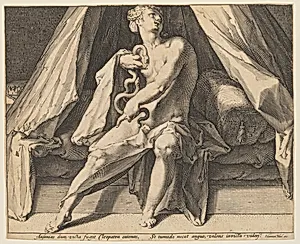
Cleopatra
c. 1590-95
Medium
Engraving on ivory laid paper
Dimensions
Sheet (trimmed): 18.7 × 22.9 cm (7 3/8 × 9 1/16 in.)
Classification
Department
Prints and Drawings
Museum
Art Institute of Chicago
Accession Number
268305
Rights
Public Domain
Art Historical Context
Jan Harmensz. Muller’s *Cleopatra*, created around 1590–95, captures the allure of the ancient Egyptian queen in a masterful engraving on ivory laid paper. Muller, a prominent Dutch artist of the Northern Mannerist school, was renowned for his intricate reproductive prints that drew from classical mythology and history. This work, measuring 18.7 × 22.9 cm, exemplifies his skill in translating elegant, elongated figures—hallmarks of Mannerism—into the precise lines of printmaking, making sophisticated imagery accessible beyond paintings. Engraving, an intaglio technique where Muller incised designs into a metal plate with a burin, allowed for rich tonal contrasts and fine details, revolutionary for the era. Printed on high-quality ivory laid paper, which provided a smooth, luminous surface, the medium enhanced the jewel-like quality of Cleopatra’s depiction, likely emphasizing her dramatic suicide by asp or regal splendor. Prints like this were vital in the late 16th century, disseminating Italian-inspired humanism across Northern Europe during a time of religious upheaval and artistic innovation. Housed in the Art Institute of Chicago’s Prints and Drawings Department, *Cleopatra* reflects the Renaissance fascination with powerful women from antiquity, blending exoticism with technical virtuosity. Visitors will appreciate how Muller’s work bridged elite patronage and public appreciation, inviting contemplation of beauty, power, and mortality.
About the Artist
Jan Harmensz. Muller · 1571–1628
Comment on works: Printer and Draughtsman