
Cœnotaphiorum (2)
Medium
Etching; first state of four
Dimensions
sheet: 9 x 5 7/8 in. (22.8 x 15 cm)
Classification
Prints|Ornament & Architecture
Department
Drawings and Prints
Museum
Metropolitan Museum of Art, New York, NY
Credit
Purchase, Phyllis D. Massar Gift, 2011
Accession Number
2011.510.2
Rights
Public Domain
Tags
Art Historical Context
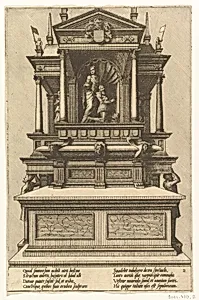
This intricate etching from 1563, titled *Cœnotaphiorum (2)*, showcases the inventive mind of Hans Vredeman de Vries, a leading Netherlandish artist celebrated for his architectural fantasies and designs. Created in collaboration with engravers Johannes and Lucas van Doetecum and publisher Hieronymus Cock, the print belongs to a series exploring cenotaphs—monumental tombs honoring the dead. As an early impression in the first of four states, it highlights the precision of etching techniques popular in the Renaissance for disseminating architectural ideas across Europe. Vredeman de Vries worked in the Mannerist tradition, blending classical motifs with imaginative perspective to create elaborate structures that influenced builders, goldsmiths, and designers throughout the Low Countries and beyond. The composition features grand architectural elements framing altars, accompanied by figures of saints and men, reflecting the era’s fascination with commemorative art amid the religious and cultural shifts of the Reformation. Acquired by the Metropolitan Museum of Art in 2011, this compact sheet (roughly 9 by 6 inches) offers a window into 16th-century print culture, where such works served both as practical models and as artistic statements on memory and devotion.