
Cœnotaphiorum (24)
Medium
Etching; first state of four
Dimensions
sheet: 9 1/16 x 5 7/8 in. (23 x 15 cm)
Classification
Prints|Ornament & Architecture
Department
Drawings and Prints
Museum
Metropolitan Museum of Art, New York, NY
Credit
Purchase, Phyllis D. Massar Gift, 2011
Accession Number
2011.510.24
Rights
Public Domain
Tags
Art Historical Context
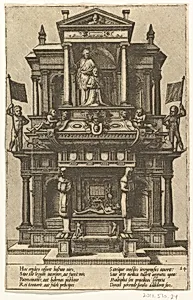
Step into the intricate world of 16th Flemish design with *Cœnotaphiorum (24)*, a masterful etching from 1563 created by architect Hans Vredeman de, engraved by the skilled brothers Johannes and Lucas van Doetecum, and published by Hieronymus. This first-state impression—measuring just 9 1/16 x 5 7/8 inches—captures Vredeman's visionary architectural fantasies, part of a renowned series showcasing elaborate cenotaphs, or monumental tombs for the illustrious dead. The print depicts a grand tomb structure adorned with caryatids—graceful female figures serving as columns—and references to Saint Peter, blending classical motifs with Northern Renaissance ingenuity. Vredeman de Vries, a pioneer in perspective and ornamental architecture, influenced Mannerist styles across Europe, while the van Doetecums' precise etching technique allowed for delicate lines and rich tonal depth, making these prints highly collectible models for architects and craftsmen. Housed in The Metropolitan Museum of Art's Drawings and Prints department (acquired via the Phyllis D. Massar Gift in 2011), this work highlights Antwerp's golden age of printmaking, where innovative designs fueled the spread of Renaissance ideals. A testament to collaborative artistry, it invites us to marvel at how such small-scale etchings shaped grand architectural ambitions.