
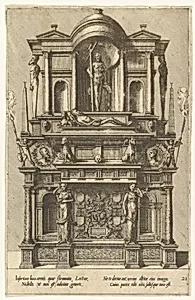
Cœnotaphiorum (21)
Medium
Etching; first state of four
Dimensions
sheet: 9 1/16 x 5 13/16 in. (23 x 14.8 cm)
Classification
Prints|Ornament & Architecture
Department
Drawings and Prints
Museum
Metropolitan Museum of Art, New York, NY
Credit
Purchase, Phyllis D. Massar Gift, 2011
Accession Number
2011.510.21
Rights
Public Domain
Tags
Art Historical Context
In the intricate etching *Cœnotaphiorum (21)* from 1563, Dutch artist Hans Vredeman Vries, a master of Northern Mannerist architecture and perspective, teams up with the renowned engraving brothers Johannes and Lucas van Doetecum. This first-state impression—rare among its four states—measures a compact 9 1/16 x 5 13/16 inches belongs to a series exploring fantastical cenotaphs, or monumental empty tombs. Housed in the Metropolitan Museum of Art's Drawings and Prints department, it exemplifies the era's fascination with elaborate ornamental designs inspired by classical antiquity. The composition bursts with Mannerist exuberance: towering caryatids—graceful female figures serving as columns—frame a richly detailed tomb structure adorned with coats of arms, symbolic corpses, and Christ figures. These elements blend Gothic intricacy with Renaissance revival, creating a dramatic, otherworldly space that evokes both mourning and grandeur. Etching's fine lines allowed the van Doetecums to capture Vredeman's precise architectural fantasies with unprecedented delicacy. Produced during the Dutch Golden Age's early stirrings, this print reflects 16th-century Europe's passion for printed pattern books, which disseminated innovative designs to architects, goldsmiths, and collectors. Its cultural weight lies in bridging art and architecture, influencing ornamental styles across Northern Europe and preserving Vredeman's visionary grotesques for posterity.