
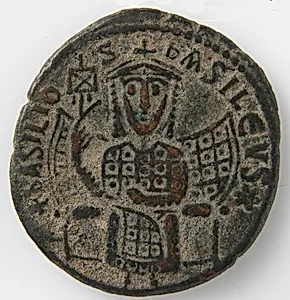
Coin of Basil I
Unknown Artist
9th century (867 or 868)
Medium
Copper alloy (catalogue card says bronze)
Dimensions
Overall: 1 x 1/16 in. (2.6 x 0.2 cm)
Classification
Coins
Culture
Byzantine
Department
Medieval Art
Museum
Metropolitan Museum of Art, New York, NY
Credit
Gift of Albert M. Lythgoe, 1917
Accession Number
17.6.94
Rights
Public Domain
Art Historical Context
This diminutive copper alloy coin, struck in 867 or 868, the visage of Basil I, the founder of Byzantium's illustrious Macedonian dynasty and emperor from 867 to 886. Measuring just 1 inch across, it exemplifies the everyday "follis" currency of the Byzantine Empire, blending economic utility with imperial propaganda. On the obverse, Basil is typically portrayed in profile, adorned with a crown and loros (a richly embroidered robe symbolizing divine authority), while the reverse bears a cross-on-steps, affirming the empire's Christian orthodoxy after the Iconoclastic Controversy. Crafted through die-striking—a precise technique where metal blanks were hammered between engraved dies—the coin's modest bronze-like patina belies its artistic finesse. Byzantine numismatics advanced portraiture in miniature, conveying the emperor's power and piety to merchants and peasants alike across a vast realm stretching from Italy to Anatolia. Such coins were vital for trade, taxation, and cultural dissemination, embodying the resilience of Byzantium amid Arab invasions and internal strife. A gift to the Metropolitan Museum of Art from Albert M. Lythgoe in 1917, this artifact invites us to ponder how even the smallest objects shaped medieval history. (198 words)