
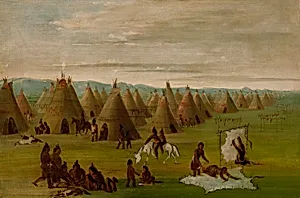
Comanche Village, Women Dressing Robes and Drying Meat
1834-1835
Medium
Painting
Classification
Painting
Department
Smithsonian Collection
Museum
Smithsonian American Art Museum
Credit
Smithsonian American Art Museum, Gift of Mrs. Joseph Harrison, Jr.
Accession Number
1985.66.346
Rights
Public Domain
Tags
About this artwork
“The village of the Camanchees,” George Catlin wrote, “is composed of six or eight hundred skin-covered lodges, made of poles and buffalo skins, in the manner precisely as those of the Sioux and other Missouri tribes . . . This village with its thousands of wild inmates, with horses and dogs, and wild sports and domestic occupations, presents a most curious scene; and the manners and looks of the people, a rich subject for the brush and the pen . . . In the view I have made of it, but a small po...
Art Historical Context
George Catlin's *Comanche Village, Women Dressinges and Drying Meat*1834–1835) captures a vivid snapshot of Comanche life on the Great Plains, painted during the artist's ambitious expedition to document Native American cultures before widespread European-American encroachment. As one of the first artists to venture into Comanche in 1834, Catlin sketched this scene firsthand, later transforming it into an oil painting that preserves a moment of everyday vitality in a village of 600–800 buffalo-skin lodges, akin to those of the Sioux. In the foreground, the chief's wigwam anchors the composition, surrounded by women expertly "graining" (scraping and softening) buffalo robes and drying meat on poles—essential tasks for survival in a nomadic, horse-centered society. Dogs, horses, and glimpses of wild sports and domestic routines fill the scene, highlighting the Comanches' self-sufficient world. Catlin's Romantic style, with its detailed realism and ethnographic eye, elevates these "rich subjects for the brush" into powerful testimonies against cultural erasure. This Smithsonian treasure underscores the Comanches' prowess as buffalo hunters and artisans, offering visitors a window into a pre-reservation era of Indigenous resilience and ingenuity.
About the Artist
George Catlin · 1796–1872
George Catlin (1796–1872), born in Wilkes-Barre, Pennsylvania, to Putnam Catlin and Polly Sutton—who had been captured by Native Americans during the 1778 Battle of Wyoming—initially pursued a legal career. Trained at Litchfield Law School, he was admitted to the bar in 1819 but abandoned law after two years to study art in Philadelphia in 1823. Self-taught as a portraitist, Catlin quickly gained ...