
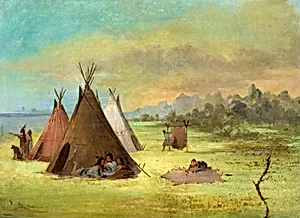
Indian Encampment, Comanche (or Kiowa) Dressing Skins, Red River
1846-1848
Medium
Painting
Classification
Painting
Department
Smithsonian Collection
Museum
Smithsonian American Art Museum
Credit
Smithsonian American Art Museum, Gift of Mrs. Joseph Harrison, Jr.
Accession Number
1985.66.597
Rights
Public Domain
Tags
About this artwork
“These people, living in a country where buffaloes are abundant, make their wigwams more easily of their skins, than of anything else; and with them find greater facilities of moving about, as circumstances often require; when they drag them upon the poles attached to their horses, and erect them again with little trouble in their new residence.” George Catlin executed this work in Paris between 1846 and 1848. (Catlin, Letters and Notes, vol. 2, no. 42, 1841; reprint 1973)
Art Historical Context
George Catlin's *Indian Encampment,anche (or Kiowa) Dressing Skins, Red River* (1846–1848) captures a vivid snapshot of Plains Indian life along the Texas Red River. Painted in Paris years after Catlin's extensive travels among Native American tribes in the 1830s, this oil painting Comanche or Kiowa figures busily dressing buffalo hides amid a cluster of teepees. Catlin, a pioneering artist and ethnographer, sought to document Indigenous cultures he feared were disappearing due to westward expansion, creating over 600 portraits and scenes in his "Indian Gallery." In his own words from *Letters and Notes* (1841), Catlin marveled at the practicality of buffalo-skin wigwams: "These people, living in a country where buffaloes are abundant, make their wigwams more easily of their skins... and with them find greater facilities of moving about." The scene highlights the nomadic efficiency of these horse-mounted warriors, whose lives revolved around the buffalo for food, shelter, and tools—a lifestyle soon disrupted by Euro-American settlement. This work exemplifies Catlin's realistic style, blending journalistic detail with romantic admiration for Native resilience. Housed in the Smithsonian American Art Museum, it remains a poignant record of pre-reservation Plains culture, inviting visitors to reflect on America's vanishing frontier.
About the Artist
George Catlin · 1796–1872
George Catlin (1796–1872), born in Wilkes-Barre, Pennsylvania, to Putnam Catlin and Polly Sutton—who had been captured by Native Americans during the 1778 Battle of Wyoming—initially pursued a legal career. Trained at Litchfield Law School, he was admitted to the bar in 1819 but abandoned law after two years to study art in Philadelphia in 1823. Self-taught as a portraitist, Catlin quickly gained ...