
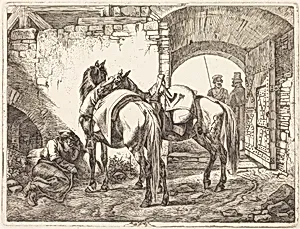
Cossack Horses in a Courtyard
Medium
etching on wove paper [proof]
Dimensions
plate: 17.1 x 22.7 cm (6 3/4 x 8 15/16 in.) sheet: 24.2 x 34.3 cm (9 1/2 x 13 1/2 in.)
Classification
Department
CG-E
Museum
National Gallery of Art, Washington, D.C.
Credit
Ailsa Mellon Bruce Fund
Accession Number
1999.14.2
Rights
Public Domain
Art Historical Context
Johann Adam Klein's *Cossack Horses in atyard* (1818) captures the raw energy and nobility of sturdy steppe horses in a sunlit enclosure, rendered as a delicate etching proof on wove. Measuring just 17.1 x 22.7 cm on the plate, this intimate print exemplifies Klein's mastery of animal subjects. A German artist active in the early 19th century, Klein was renowned for his vivid depictions of horses, blending Romantic enthusiasm for nature's vitality with precise draftsmanship influenced by English sporting art traditions. Created shortly after the Napoleonic Wars, the work evokes the era's fascination with Cossacks—fierce horsemen from the Russian steppes whose cavalry prowess shaped European battlefields. These resilient horses symbolize endurance and exotic allure, themes resonant in post-war Romanticism, which celebrated the untamed spirit of the natural world amid industrial change. The etching technique, where acid etches intricate lines into a copper plate, allowed Klein to achieve fine textures—from the horses' rippling muscles to the courtyard's shadowed stones—making this proof a rare glimpse into his iterative creative process. Housed in the National Gallery of Art's collection through the Ailsa Mellon Bruce Fund, this print highlights etching's role in democratizing art, enabling affordable multiples of elite subjects. Visitors will appreciate its lively detail, inviting a closer look at history through equine eyes.
About the Artist
Johann Adam Klein · 1792–1875
Swedish artist, resided in Copenhagen after 1758. Comment on works: genre; lithographer