
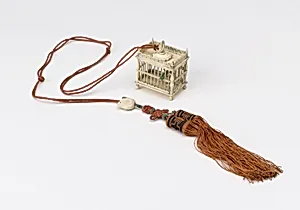
cricket cage
late 19th century
Classification
containers
Department
Smithsonian Collection
Museum
Smithsonian American Art Museum
Credit
Gift of Eleanor and Sarah Hewitt
Accession Number
1916-19-103-a,b
Rights
Public Domain
About this artwork
Rectangular cage (a) with turned corner posts terminating in pointed finials at top, ball feet; pierced gallery around top edges; hinged door at one side; rectangular, partitioned 'food trough' in cage, next to door; two red and orange ivory birds sit on flat green perch suspended in cage. Orange silk cord attached to ring at top of cage, and decorated with orange and black tassel, flat ivory bird (b), and knotted green bands near tassel.
Art Historical Context
This exquisite late 19th-century cage, a delicate container from the Smithsonian American Art Museum collection, showcases the artistry of everyday life in East Asia. Crafted with turned wooden corner posts topped by pointed finials and ball feet, it features a gallery along the top edges for ventilation and a hinged door for access. Inside, a partitioned food trough sits beside a flat green perch holding two vibrant red and orange ivory birds,oking a serene miniature world. An orange silk cord adorned with a tassel, a flat ivory bird, andotted green bands, allows for elegant suspension. In Chinese culture, cricket cages like this one were cherished by poets, scholars, and common folk alike during autumn, when crickets' chirps symbolized melancholy beauty or good fortune. Kept as pets for their song or in gentle contests, they blended utility with whimsy, often elaborately decorated to reflect the owner's refinement. The use of ivory for the birds highlights fine carving techniques, while the silk cord adds a luxurious touch, suggesting this piece may have been a high-end example, possibly from export workshops. A gift from collectors Eleanor and Sarah Hewitt, this cage now captivates in the Smithsonian's decorative arts holdings, reminding us how small objects carried profound cultural resonance. Its intricate details invite visitors to ponder the intimate joys of historical pastimes.
About the Artist
Unknown
The artist designated as "Unknown" in our virtual museum's collection exemplifies a poignant chapter in art history: creators whose identities have faded into obscurity despite the enduring power of their work. With only one known artwork attributed to them in our holdings, this figure represents countless anonymous hands that shaped visual culture across centuries. Museums worldwide, including th...