
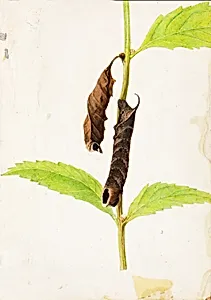
Curled Dead Leaf Mimicking Sphinx Caterpillar, study for book Concealing Coloration in the Animal Kingdom
n.d.
Medium
Painting
Classification
Painting
Department
Smithsonian Collection
Museum
Smithsonian American Art Museum
Credit
Smithsonian American Art Museum, Gift of the heirs of Abbott Handerson Thayer
Accession Number
1950.2.27B
Rights
Public Domain
Tags
Art Historical Context
Behold the intricate "Curled Dead Leaficking Sphinx Caterpillar," a captivating painting by Gerald H. Thayer created as a study for the book *Concealingoration in the Animal Kingdom This undated work, housed in the Smithsonian American Art, masterfully captures nature's genius for disguise: a sphinx caterpillar curled in perfect imitation of a withered leaf, blending seamlessly into its surroundings. Through delicate brushwork in oil or watercolor—typical of scientific studies—Thayer highlights the subtle tones and textures that fool predators, turning observation into revelation. Gerald H. Thayer, son of the renowned naturalist painter Abbott Handerson Thayer, continued his father's pioneering research into protective coloration. Gifted to the museum by Abbott's heirs, this piece exemplifies the Thayers' fusion of art and science at the turn of the 20th century. Their work influenced military camouflage during World War I and advanced evolutionary biology, proving how animals "conceal" through countershading and mimicry. As a study painting, it invites visitors to marvel at camouflage's artistry, bridging museum walls with the wild. Spot the caterpillar's leaf-like veins and shadows—nature's own masterpiece, rendered with precision for all to ponder.