
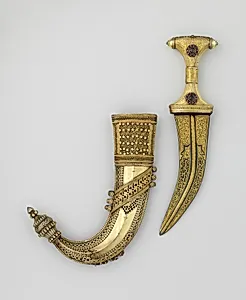
Dagger (Jambiya) with Scabbard and Fitted Storage Case
Unknown Artist
1876–1909
Medium
Steel, silver, wood, textile, gold
Dimensions
L. of dagger with scabbard 12 3/4 in. (32.4 cm); Wt. of dagger with scabbard (642.0 g); Dagger: L. 11 1/16 in. (28.1 cm); L. of blade 6 3/4 in. (17.2 cm); W. 2 7/8 in. (7.3 cm); Wt. 9.1 oz. (258 g); Scabbard: L. 8 7/8 in. (22.5 cm); Wt. 13.7 oz. (388.4 g); Case: H. 14 in. (35.6 cm); W. 3 1/2 in. (8.9 cm); Wt. 10.8 oz. (306.2 cm)
Classification
Daggers
Culture
Arabian, Medina
Department
Arms and Armor
Museum
Metropolitan Museum of Art, New York, NY
Credit
Rogers Fund, 1931
Accession Number
31.35.1a–c
Rights
Public Domain
Art Historical Context
This exquisite Jambiya dagger, complete with its ornate scabbard and fitted case, hails from Medina in the Arabian Peninsula, crafted between 1876 and1909. Measuring about 12¾ inches long with its scabbard, this-bladed weapon exemplifies the fusion of functionality and finery in late 19th-century Arabian. The Jambiya, a curved dagger iconic to the region, was more than a tool for defense—it served as a symbol of manhood, social status, and tribal identity, often displayed prominently at the waist. The dagger's artistic significance shines through its lavish materials: a sharp steel blade housed in a scabbard of wood, silver, textile, and gold accents. These elements highlight masterful metalworking techniques, with silver and gold likely embossed or filigreed to evoke wealth and prestige. Weighing nearly 23 ounces together, the dagger and scabbard reflect durable yet elegant craftsmanship, while the velvet-lined case (14 inches high) underscores its role as a treasured heirloom. Housed in the Metropolitan Museum of Art's Arms and Armor Department (Rogers Fund, 1931), this piece offers a window into Medina's vibrant cultural heritage, where such ornate weapons bridged utility and artistry in a time of regional trade and tradition.