
Dagger (Jambiya) with Sheath
Unknown Artist
19th century
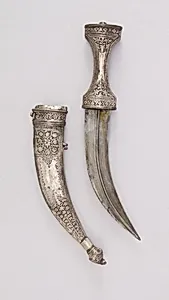
Medium
Steel, silver, wood, turquoise
Dimensions
H. with sheath 12 1/4 in. (31.1 cm); H. without sheath 11 1/4 in. (28.6 cm); H. of blade 7 3/8 in. (18.7 cm); W. 1 15/16 in. (4.9 cm); Wt. 5 oz. (141.7 g); Wt. of sheath 2.9 oz. (82.2 g)
Classification
Daggers
Culture
Indian
Department
Arms and Armor
Museum
Metropolitan Museum of Art, New York, NY
Credit
Bequest of George C. Stone, 1935
Accession Number
36.25.1052a, b
Rights
Public Domain
Art Historical Context
This exquisite 19th-century Jambiya dagger with sheath, hailing from India, exemplifies the blend of functionality and opulence in South Asian arms and armor. Measuring just over 12 inches with its sheath, the weapon features a steel blade about 7⅜ inches long, elegantly curved in the characteristic Jambiya style—often symbolizing a man's status and prowess in martial traditions. Crafted from steel, silver, wood, and turquoise, its hilt and fittings showcase intricate metalwork and gemstone inlays, transforming a tool of defense into a work of wearable art. In the turbulent landscape of 19th-century India, amid princely states and colonial influences, such daggers were more than mere weapons; they were status symbols for warriors, nobles, and dignitaries. The lavish use of silver and turquoise highlights advanced silversmithing techniques, where artisans damascened or overlaid metals for durability and dazzle. Turquoise, prized for its protective qualities in Indian and Islamic cultures, added spiritual significance. Now housed in the Metropolitan Museum of Art's Arms and Armor Department, thanks to the 1935 bequest of collector George C. Stone, this piece invites us to ponder the artistry behind India's storied martial heritage—where beauty met bravery.