
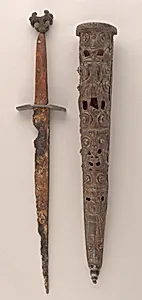
dagger
ca. 1400–1500
Classification
cutlery
Department
Smithsonian Collection
Museum
Smithsonian American Art Museum
Credit
The Robert L. Metzenberg Collection, gift of Eleanor L. Metzenberg
Accession Number
1985-103-41-b
Rights
Public Domain
About this artwork
Research in Progress
Art Historical Context
This enigmatic dagger, dating to circa 14001500, hails from the late medieval or early Renaissance period, a time when such blades were essential tools in daily life. Classified as cutlery within the Smithsonian American Art Museum's collection, it likely served dual purposes: as a personal eating utensil at communal tables—where diners supplied their own knives—and as a practical sidearm for self-defense. With its artist and medium unknown, the piece invites us to ponder the skilled, anonymous craftsmanship of Europe's workshops, where form met function in everyday objects. Daggers like this one highlight the cultural interplay of utility and status in the 15th century. Nobles and commoners alike carried them, often embellishing hilts with intricate designs to signal wealth, though specifics here remain elusive amid ongoing research. Its presence in the Smithsonian underscores how arms and implements from this era crossed oceans to enrich American collections. From The Robert L. Metzenberg Collection, gifted by Eleanor L. Metzenberg, this artifact awaits further study, promising revelations about medieval material culture. Visitors, imagine wielding it at a feast— a tangible link to history's hearth and hall. (198 words)
About the Artist
Unknown
The artist designated as "Unknown" in our virtual museum's collection exemplifies a poignant chapter in art history: creators whose identities have faded into obscurity despite the enduring power of their work. With only one known artwork attributed to them in our holdings, this figure represents countless anonymous hands that shaped visual culture across centuries. Museums worldwide, including th...