
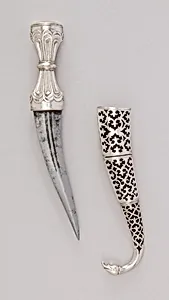
Dagger with Sheath
Unknown Artist
18th–19th century
Medium
Steel, silver, wood
Dimensions
H. with sheath 10 1/8 in. (25.7 cm); H. without sheath 8 5/8 in. (21.9 cm); H. of blade 5 1/4 in. (13.3 cm); W. 1 5/16 in. (3.3 cm); Wt. 6.3 oz. (178.6 g); Wt. of sheath 3.4 oz. (96.4 g)
Classification
Daggers
Culture
South Indian
Department
Arms and Armor
Museum
Metropolitan Museum of Art, New York, NY
Credit
Bequest of George C. Stone, 1935
Accession Number
36.25.764a, b
Rights
Public Domain
Art Historical Context
This exquisite *Dagger with Sheath* from South India, dating to the 18th–19th century, exemplifies the region's masterful blend of functionality and artistry in arms and armor. Crafted by an unknown artisan, the dagger features a steel blade measuring 5¼ inches long, housed in a fitted sheath of wood adorned with silver elements. At just 6.3 ounces without its 3.4-ounce sheath, its compact size—standing 10⅛ inches tall sheathed—made it ideal for close combat or as a concealed sidearm for warriors and nobility during a time of regional kingdoms and colonial encounters. The materials highlight South Indian metallurgical prowess: the resilient steel blade ensured deadly precision, while silver inlays and fittings added ornamental elegance, often symbolizing status. Wooden sheaths provided practical protection and portability. Such daggers were cultural icons, used not only in battle but also in ceremonial contexts, reflecting the martial traditions of Dravidian societies. Now housed in the Metropolitan Museum of Art's Arms and Armor Department through the 1935 bequest of George C. Stone, this piece invites visitors to ponder the artistry behind everyday weapons of history. (198 words)