
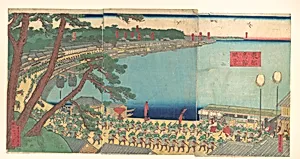
Daimyo's Processions Passing along the Tōkaidō
19th century
Medium
Triptych of woodblock prints; ink and color on paper
Dimensions
Image (j): 14 1/8 x 9 5/8 in. (35.9 x 24.4 cm) Image (k): 14 1/8 x 9 1/2 in. (35.9 x 24.1 cm) Image (l): 14 1/4 x 9 1/2 in. (36.2 x 24.1 cm)
Classification
Prints
Culture & Period
Japan · Edo period (1615–1868)
Department
Asian Art
Museum
Metropolitan Museum of Art, New York, NY
Credit
Bequest of William S. Lieberman, 2005
Accession Number
2007.49.293a–c
Rights
Public Domain
Tags
Art Historical Context
This striking triptych by Utagawa Sadahide captures the grandeur of daimyo processions traveling along Japan’s historic Tōkaidō highway during the Edo period. Created in the 19th century as a set of three woodblock prints, the work depicts the elaborate retinues of feudal lords making their required journeys between their domains and the capital in Edo. Sadahide, a skilled member of the influential Utagawa school, uses the panoramic format of the triptych to convey both scale of these processions and the lively roadside activity that accompanied them. The Tōkaidō route was one of Japan’s most vital arteries, linking Kyoto and Edo, and the sankin-kōtai system mandated that daimyo travel with large entourages, turning these trips into displays of power and wealth. Sadahide’s detailed rendering brings this bustling world to life, highlighting the colorful banners, palanquins, and figures that would have lined the road. As a ukiyo-e woodblock print in ink and color on paper, the triptych exemplifies the technical brilliance of Japanese printmaking, where multiple carved blocks allowed for vibrant hues and intricate patterns. Such works offered museum visitors today a vivid window into Edo-era travel, status, and everyday spectacle along one of Japan’s most famous routes.
About the Artist
Utagawa (Gountei) Sadahide · 1807–1873
Utagawa Sadahide was born Hashimoto Kenjirō in 1807 in Fusa Province, in the area of modern Chiba Prefecture, Japan. In the 1820s he entered the studio of the enormously prolific and influential master Utagawa Kunisada, becoming one of Kunisada's most prominent pupils and adopting the studio name Sadahide along with the Utagawa school's celebrated lineage. By 1828 his name appeared on a monument l...