
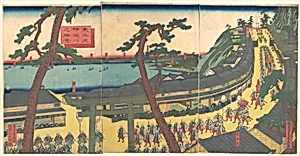
View of Kanagawa on the Tōkaidō Road (Tōkaidō kanagawa no shōkei)
ca. 1862–63
Medium
Triptych of woodblock prints; ink and color on paper
Dimensions
Image (a): 14 1/2 x 9 1/2 in. (36.8 x 24.1 cm) Image (b): 14 1/2 x 9 3/8 in. (36.8 x 23.8 cm) Image (c): 14 3/8 x 9 1/2 in. (36.5 x 24.1 cm)
Classification
Prints
Culture & Period
Japan · Edo period (1615–1868)
Department
Asian Art
Museum
Metropolitan Museum of Art, New York, NY
Credit
Bequest of William S. Lieberman, 2005
Accession Number
2007.49.290a–c
Rights
Public Domain
Tags
Art Historical Context
This striking triptych by Utagawa Sadahide captures a lively scene along the Tōkaidō, Japan’s most important highway the Edo period, linking (modern Tokyo) with Kyoto. Created around 1862–63, the work shows travelers, processions, and boats along the coastal route at Kanagawa, rendered in vibrant ink and color on paper. As a leading artist of the Utagawa school, Sadahide specialized in ukiyo-e prints that documented changing landscapes and daily life with both precision and charm. The triptych format was especially suited to panoramic views like this one, allowing the composition to unfold across three sheets and convey the road’s bustling energy. Woodblock printing, a collaborative medium involving designers, carvers, and printers, made such colorful images widely accessible to the public. Sadahide’s attention to human figures, boats, and the winding road highlights the Tōkaidō’s role as a vital artery of commerce, pilgrimage, and cultural exchange in late Edo Japan. Today, this print offers a vivid glimpse into a world on the cusp of modernization, preserving the spirit of travel and movement that defined the era.
About the Artist
Utagawa (Gountei) Sadahide · 1807–1873
Utagawa Sadahide was born Hashimoto Kenjirō in 1807 in Fusa Province, in the area of modern Chiba Prefecture, Japan. In the 1820s he entered the studio of the enormously prolific and influential master Utagawa Kunisada, becoming one of Kunisada's most prominent pupils and adopting the studio name Sadahide along with the Utagawa school's celebrated lineage. By 1828 his name appeared on a monument l...