
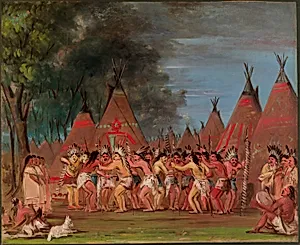
Dance of the Chiefs, Mouth of the Teton River
1832-1833
Medium
Painting
Classification
Painting
Department
Smithsonian Collection
Museum
Smithsonian American Art Museum
Credit
Smithsonian American Art Museum, Gift of Mrs. Joseph Harrison, Jr.
Accession Number
1985.66.436
Rights
Public Domain
Tags
About this artwork
“In this dance, which I have called ‘the dance of the chiefs,’ for want of a more significant title, was given by fifteen or twenty chiefs and doctors; many of whom were very old and venerable men. All of them came out in their head-dresses of war-eagle quills, with a spear or staff in the left hand, and a rattle in the right. It was given in the midst of he Sioux village, in front of the head chief's lodge, and beside the medicine-man who beat on the drum, and sang for the dance, there were fou...
Art Historical Context
George Catlin's *Dance of the Chiefs, Mouth the Teton River*1832–1833) captures a vibrant Sioux (Dakota) ceremonial witnessed by the artist during his travels among Native American tribes in the early 1830s. Catlin, a pioneering painter and ethnographer, journeyed westward to document indigenous cultures before they were profoundly changed by European-American expansion. This oil painting, likely sketched and possibly even completed on-site near Fort Pierre in present-day South Dakota, reflects urgent mission to preserve these traditions through art. In the scene, fifteen to twenty venerable chiefs and medicine men perform in full regalia—war-eagle quill headdresses, spears or staffs in one hand, rattles in the other—before the head chief's lodge in the heart of the village. A medicine man drums and sings, accompanied by four young women chanting a chorus, a rare instance Catlin noted of women participating alongside men in such rituals. This lively depiction highlights the communal spirit and spiritual depth of Sioux life. As part of Catlin's renowned "Indian Gallery," the painting holds immense historical and cultural value, offering a firsthand glimpse into pre-reservation Native American practices. Housed in the Smithsonian American Art Museum, it reminds us of the artistry and resilience of the Dakota people.
About the Artist
George Catlin · 1796–1872
George Catlin (1796–1872), born in Wilkes-Barre, Pennsylvania, to Putnam Catlin and Polly Sutton—who had been captured by Native Americans during the 1778 Battle of Wyoming—initially pursued a legal career. Trained at Litchfield Law School, he was admitted to the bar in 1819 but abandoned law after two years to study art in Philadelphia in 1823. Self-taught as a portraitist, Catlin quickly gained ...