
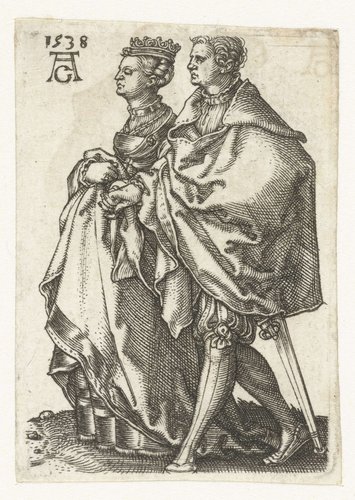
Dansend paar
Medium
engraving
Dimensions
37; 53
Rights
Public Domain
About this artwork
plaatrand: hoogte 53 mm x breedte 37 mm
Art Historical Context
**Dansend Paar (Dancing Couple *Heinrich Aldegre, 1538, Engraving, 53 × 37 mm* Step into the lively world of 16th-century Northern Renaissance with Heinrich Aldegrever enchanting engraving *Dansend Paar*, "Dancing Couple." Created in 1538, this gem captures a joyful pair mid-dance, their flowing garments and expressive poses evoking the festive spirit of Renaissance social life. Aldegrever, a goldsmith and master engraver from Soest (c. 1502–1555), was one of the celebrated "Little Masters," renowned for their virtuosic small-scale prints that rivaled painting in detail. As an engraving, the work showcases the precision of the burin tool, incised into a copper plate to create fine, shimmering lines that hold ink for printing. At just 53 by 37 mm—smaller than a modern postcard—Aldegrever's technical prowess shines, rendering textures like fabric folds and dynamic movement with extraordinary clarity. This medium democratized art, allowing prints to circulate widely across Europe, spreading Renaissance humanism and secular themes beyond elite patrons. *Dansend Paar* reflects the era's growing fascination with everyday pleasures, blending German precision with Italianate grace influenced by Albrecht Dürer. A delightful window into 1530s courtly revelry, it invites us to imagine the music and merriment of long-ago feasts. (198 words)
About the Artist
Heinrich Aldegrever · 1502–1561
Heinrich Aldegrever, born in 1502 in Paderborn, Westphalia, to parents Herman and Katherine Trippenmeker—a family of clog-makers known by the dialect name Trippenmecker—emerged as a multifaceted artist in the German Renaissance. His early training remains undocumented, though he likely apprenticed in a Soest goldsmith's workshop after relocating there around 1525, where he joined the painters' gui...