
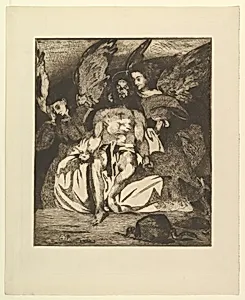
Dead Christ with Angels
1866–67
Medium
Etching and aquatint in brown/black ink; third state of three
Dimensions
plate: 15 1/2 x 12 7/8in. (39.4 x 32.7cm) sheet: 17 3/4 x 14 1/2in. (45.1 x 36.8cm)
Classification
Prints
Department
Drawings and Prints
Museum
Metropolitan Museum of Art, New York, NY
Credit
Purchase, Florance Waterbury Bequest, 1970
Accession Number
1970.572
Rights
Public Domain
Tags
Art Historical Context
In the hallowed tradition of religious art, *Dead Christ with Angels* (1866–67) together the visionary talents of Édouard Man, a pioneering French artist on the cusp of Impressionism, and master printmaker Henri Guérard. poignant etching and aquatint warm brown-black ink captures the somber aftermath of the Crucifixion, with Christ's lifeless form tenderly attended by angels—a theme evoking profound themes of death, sacrifice, and divine compassion. Produced in the third and final state of three, it reflects meticulous refinement, allowing for deeper tonal contrasts and intricate details in the figures' drapery and expressions. Manet's collaboration with Guérard highlights the era's innovative printmaking techniques. Etching provided precise line work for the composition's dramatic contours, while aquatint added velvety textures and subtle gradations, mimicking the luminosity of oil painting. At 15½ × 12⅞ inches on the plate, this intimate work was part of Manet's broader experiments in reproductive prints during the 1860s, bridging classical religious iconography with his emerging realist style. Acquired by The Metropolitan Museum of Art through the Florance Waterbury Bequest in 1970, it invites visitors to ponder mortality and spirituality through Manet's unflinching gaze.
About the Artist
Edouard Manet|Henri Guérard · 1832–1883
Édouard Manet (1832-1883) was a French painter who played a pivotal role in the transition from Realism to Impressionism, often called the 'Father of Modern Art.' Born into a wealthy Parisian family, Manet defied his father's wishes for a legal career to pursue painting, studying under academic artist Thomas Couture. His revolutionary works 'Le Déjeuner sur l'herbe' and 'Olympia' (both 1863) scand...