
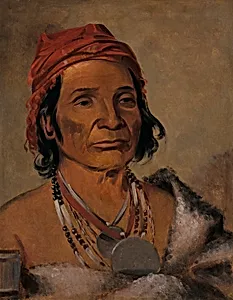
Deep Lake, an Old Chief
1831
Medium
Painting
Classification
Painting
Department
Smithsonian Collection
Museum
Smithsonian American Art Museum
Credit
Smithsonian American Art Museum, Gift of Mrs. Joseph Harrison, Jr.
Accession Number
1985.66.264
Rights
Public Domain
Tags
About this artwork
In 1830, Catlin accompanied William Clark, of the celebrated Lewis and Clark expedition, up the Mississippi River from St. Louis to Fort Crawford. Before he began more extensive travels in 1832, however, he spent time in eastern cities, where he often saw visiting delegations of Native Americans and was able to paint their portraits. In Washington, D.C., in January and February 1831, Catlin painted Menominee and Seneca delegations, including this portrait of the Ohio Seneca chief Deep Lake. The ...
Art Historical Context
**Deep Lake, an Old Chief** (1831) by Georgelin captures the dignified likeness of a Seneca leader from Ohio, painted during a pivotal moment in American history. Catlin, a pioneering 19th-century artist renowned for his extensive portraits of Indigenous peoples, created this oil painting in Washington, D.C., amid the chief's visit with a tribal delegation. These striking portraits, often rendered with meticulous detail and a sense of immediacy, reflect Catlin mission to document Native cultures before they were irrevocably altered by American expansion. The artwork's historical context is deeply tied to the era's forced land cessions. In early 1831, Deep Lake and his fellow Senecas traveled to the capital to negotiate the sale of their ancestral lands south of Lake Erie, part of broader U.S. policies pressuring tribes to relinquish territories. By 1838, the Treaty of Buffalo Creek mandated their removal to present-day Kansas, symbolizing the tragic displacement of many Eastern tribes. Catlin's work, including this portrait, serves as a poignant visual record of these leaders' resilience and presence. Housed in the Smithsonian American Art Museum, this piece highlights Catlin's ethnographic approach—blending portraiture with cultural preservation. Visitors are drawn to its intimate portrayal of Deep Lake's thoughtful gaze, inviting reflection on the human stories behind America's complex frontier narrative.
About the Artist
George Catlin · 1796–1872
George Catlin (1796–1872), born in Wilkes-Barre, Pennsylvania, to Putnam Catlin and Polly Sutton—who had been captured by Native Americans during the 1778 Battle of Wyoming—initially pursued a legal career. Trained at Litchfield Law School, he was admitted to the bar in 1819 but abandoned law after two years to study art in Philadelphia in 1823. Self-taught as a portraitist, Catlin quickly gained ...