
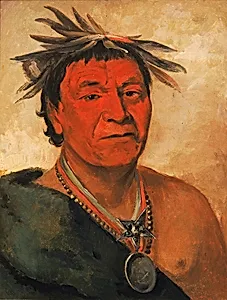
O-ho-páh-sha, Small Whoop, a Distinguished Warrior
1831
Medium
Painting
Classification
Painting
Department
Smithsonian Collection
Museum
Smithsonian American Art Museum
Credit
Smithsonian American Art Museum, Gift of Mrs. Joseph Harrison, Jr.
Accession Number
1985.66.229
Rights
Public Domain
Tags
About this artwork
George Catlin described Small Whoop, a member of the Menominee tribe, as a “hard-visaged warrior, of most remarkable distinction.” The artist probably painted this portrait in Washington in 1831. (Catlin, 1848 Catalogue, Catlin’s Indian Gallery, SAAM online exhibition)
Art Historical Context
**O-ho-páh-sha, Small Whoop, a Warrior** (1831) is a compelling portrait by George Catlin the pioneering 19th-century artist renowned for his ethnographic documentation of Native American peoples. Captured likely in Washington, D.C this oil painting depicts Small Whoop (O-ho-páh-sha), a prominent warrior of the Menominee tribe from the Lakes region. Catlin described him as a "-visaged warrior, of remarkable distinction," highlighting the subject's fierce demeanor and status within his community. Painted during a period of rapid cultural upheaval for Indigenous nations, the portrait reflects Catlin's urgent mission to record Native American life before Western expansion altered it forever. As part of his vast "Indian Gallery"—a collection of over 600 works—this piece exemplifies Catlin's realistic style, emphasizing dignified facial features, traditional attire, and piercing gazes to convey authenticity and humanity. Today, housed in the Smithsonian American Art Museum (gift of Mrs. Joseph Harrison, Jr.), it stands as a vital cultural artifact, preserving the legacy of Menominee resilience and Catlin's role in early American portraiture. Visitors are invited to ponder the warrior's story through Catlin's unflinching lens.
About the Artist
George Catlin · 1796–1872
George Catlin (1796–1872), born in Wilkes-Barre, Pennsylvania, to Putnam Catlin and Polly Sutton—who had been captured by Native Americans during the 1778 Battle of Wyoming—initially pursued a legal career. Trained at Litchfield Law School, he was admitted to the bar in 1819 but abandoned law after two years to study art in Philadelphia in 1823. Self-taught as a portraitist, Catlin quickly gained ...