
Der Ernährer (The Bread Winner)
1920
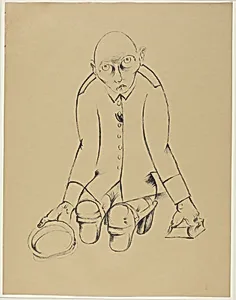
Medium
lithograph on pale brown paper
Dimensions
sheet: 59 x 46 cm (23 1/4 x 18 1/8 in.)
Classification
Portfolio
Department
CG-W
Museum
National Gallery of Art, Washington, D.C.
Credit
Gift of the Collectors Committee
Accession Number
2006.24.3
Rights
Public Domain
Art Historical Context
**Der Ernährer ( Bread Winner)**, a poignant 1920 lithograph by Heinrich Hoerle, captures the struggles of everyday life in post-World War I Germany. Created during the turbulent Weimar Republic, when economic devastation and hyperinflation gripped the nation, Hoerle—a founding member of the Cologne Progress group—depicted the burdens of the working class. The title evokes the archetype of the family provider, likely rendered in the stark, angular style of New Objectivity (Neue Sachlichkeit), which emphasized social realities over idealism. Printed on pale brown paper (sheet: 59 x 46 cm), this lithograph exemplifies the medium's power for accessible dissemination. Lithography, a planographic technique using grease crayon on stone or metal, allowed artists like Hoerle to produce multiples affordably, making potent social commentary available beyond elite circles. As part of a portfolio (Department: CG-W), it reflects the era's print portfolios that amplified avant-garde voices amid political unrest. Housed in the National Gallery of Art through the Collectors Committee's gift, *Der Ernährer* stands as a testament to art's role in witnessing human resilience. Hoerle's work invites us to reflect on timeless themes of labor and survival, bridging historical hardship with universal empathy.
About the Artist
Heinrich Hoerle · 1885–1936
Heinrich Hoerle, born on September 1, 1895, in Cologne, Germany, emerged as a pivotal figure in the radical art scene of the Weimar Republic. He studied at the Cologne School of Arts and Crafts but was largely self-taught, honing his skills amid the turmoil of World War I. In 1919, he married fellow artist Angelika Hoerle (née Fick), with whom he plunged into Cologne's Dada movement, co-founding t...