
Der Erwerbslose (The Unemployed Man)
1920
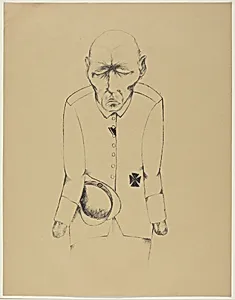
Medium
lithograph on pale brown paper
Dimensions
sheet: 59 × 46 cm (23 1/4 × 18 1/8 in.)
Classification
Portfolio
Department
CG-W
Museum
National Gallery of Art, Washington, D.C.
Credit
Gift of the Collectors Committee
Accession Number
2006.24.4
Rights
Public Domain
Art Historical Context
**Der ErwerbsloseThe Unemployed Man)**, a poignant 1920 lithograph by Heinricherle, captures the harsh of post-World War I Germany. Hoerle, a key figure in the Cologne Progressives (Gruppe Progress),-founded this Rhineland avant-garde group to confront social upheaval through stark, unflinching art. Created amid the Weimar Republic's economic turmoil—marked by hyperinflation, demobilization, and mass unemployment—this print reflects the era's widespread desperation, portraying an everyman stripped of dignity and purpose. Printed on pale brown paper, the lithograph's earthy tone evokes worn-out lives, while the medium's precision allowed for bold lines and reproducible social commentary. Measuring 59 × 46 cm, it was likely part of a portfolio designed for broader dissemination, amplifying its message beyond elite galleries. Hoerle's style aligns with New Objectivity (Neue Sachlichkeit), favoring raw realism over expressionist excess to document human suffering. Today, housed in the National Gallery of Art as a gift from the Collectors Committee, this work reminds us of art's power to humanize crisis. It stands as a timeless testament to resilience amid adversity, inviting visitors to reflect on labor's fragility in turbulent times.
About the Artist
Heinrich Hoerle · 1885–1936
Heinrich Hoerle, born on September 1, 1895, in Cologne, Germany, emerged as a pivotal figure in the radical art scene of the Weimar Republic. He studied at the Cologne School of Arts and Crafts but was largely self-taught, honing his skills amid the turmoil of World War I. In 1919, he married fellow artist Angelika Hoerle (née Fick), with whom he plunged into Cologne's Dada movement, co-founding t...