
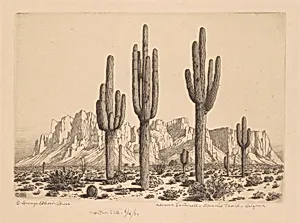
Desert Sentinels, Apache Trail, Arizona
c. 1930
Medium
etching in black on wove paper
Dimensions
plate: 13.18 × 18.73 cm (5 3/16 × 7 3/8 in.) sheet: 21.59 × 27.31 cm (8 1/2 × 10 3/4 in.)
Classification
Department
CG-W
Museum
National Gallery of Art, Washington, D.C.
Credit
Corcoran Collection (Bequest of Frank B. Bristow)
Accession Number
2015.143.88
Rights
Public Domain
Art Historical Context
**Desert Sentinels, Apache Trail, Arizona** (c. 1930) by George Elbert Burr captures the majesty of Arizona's rugged landscapes along the historic Apache Trail. This etching depicts towering rock formations—aptly named "sentinels"—standing guard over the sun-baked desert, evoking the untamed beauty of the American Southwest. Burr, a prominent etcher of the early 20th, was renowned for his luminous depictions of Western scenery, blending realism with atmospheric effects to romanticize the region's dramatic geology. Printed in black ink on wove paper, the work exemplifies etching's precision: Burr incised fine lines into a metal plate, allowing acid to etch intricate textures that mimic rocky surfaces and distant horizons. Measuring just 13.18 × 18.73 cm on the plate, its intimate scale invites close viewing, highlighting the medium's role in the etching revival, where artists elevated prints to fine art status amid growing interest in American regionalism. Now part of the National Gallery of Art's Corcoran Collection (Bequest of Frank B. Bristow), this piece reflects 1930s fascination with natural wonders during the push for national parks and tourism. Burr's vision endures as a poetic tribute to Arizona's enduring allure, bridging art and exploration for generations of visitors.
About the Artist
George Elbert Burr · 1859–1939
George Elbert Burr was an American printmaker and watercolorist whose career spanned the late nineteenth and early twentieth centuries, earning him a reputation as one of the foremost etchers of the American West. Born in 1859 in Monroe Falls, Ohio, Burr trained as a commercial illustrator before turning his full attention to fine art. He honed his craft through diligent self-study and close obser...