
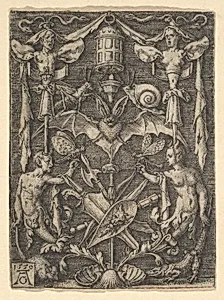
Design for a Candelabra Grotesque with a Bat in the Center
Medium
Engraving
Dimensions
Sheet: 2 11/16 x 2 in. (6.8 x 5.1 cm)
Classification
Prints|Ornament & Architecture
Department
Drawings and Prints
Museum
Metropolitan Museum of Art, New York, NY
Credit
Bequest of Phyllis Massar, 2011
Accession Number
2012.136.783
Rights
Public Domain
Tags
Art Historical Context
Heinrich Aldegrever's *Design for a Candel Grotesque with a in the Center* (1550) is a exquisite example of Renaissance ornamental engraving from the Northern German tradition. Aldegrever, one of the renowned "Little Masters," specialized in intricate small-scale prints like this one, measuring just 2 11/16 x 2 inches. Created as an engraving—a meticulous technique where the artist incised fine lines into a metal plate for inking and printing—this work exemplifies the precision possible in miniature formats, ideal for disseminating decorative ideas across Europe. Grotesques, inspired by ancient Roman frescoes rediscovered during the Renaissance, blend fantastical flora, fauna, and architecture into whimsical designs. Here, a central bat anchors a candelabra form, surrounded by insects and snails, evoking a playful yet eerie natural world. Such prints served as models for goldsmiths, silversmiths, and architects, fueling the era's passion for elaborate metalwork and furnishings amid the opulent courts of the Holy Roman Empire. Housed in the Metropolitan Museum of Art's Drawings and Prints department, this piece highlights Aldegrever's versatility beyond portraits, showcasing his flair for the bizarre and beautiful. Visitors will appreciate how it captures 16th-century ingenuity, where everyday objects like candelabras became canvases for imaginative grotesquerie.
About the Artist
Heinrich Aldegrever · 1502–1561
Heinrich Aldegrever, born in 1502 in Paderborn, Westphalia, to parents Herman and Katherine Trippenmeker—a family of clog-makers known by the dialect name Trippenmecker—emerged as a multifaceted artist in the German Renaissance. His early training remains undocumented, though he likely apprenticed in a Soest goldsmith's workshop after relocating there around 1525, where he joined the painters' gui...