
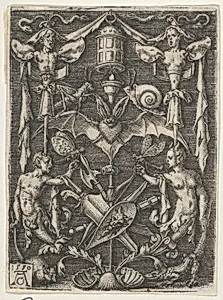
Ornamental Design with a Bat in the Center
Medium
Engraving
Dimensions
Sheet: 2 3/4 × 2 in. (7 × 5.1 cm)
Classification
Prints|Ornament & Architecture
Department
Drawings and Prints
Museum
Metropolitan Museum of Art, New York, NY
Credit
Rogers Fund, 1920
Accession Number
21.11.4
Rights
Public Domain
Tags
Art Historical Context
Heinrich Aldegrever, a masterful German engraver and goldsmith active during the Northern Renaissance, crafted *Ornamental Design with Bat in the Center* 1550. Thisutive engraving, measuring just 2¾ × 2 inches, exemplifies the "Little Masters" styleartists renowned for their exquisitely detailed small-scale prints. Housed in the Metropolitan Museum of Art's Drawings and Prints department, it was acquired through the Rogers Fund in 0. At its heart, a bat commands attention, encircled by whimsical motifs like playful satyrs, delicate dragonflies, and curling shells. These elements evoke the grotesque ornamental style inspired by ancient Roman discoveries, blending natural observation with fantastical invention. Aldegrever's precise engraving technique—incising lines into a copper plate with a burin—allowed for intricate textures and fine shading, ideal for capturing the organic flow of foliage and mythical figures. Such prints held practical significance as pattern books for Renaissance artisans, guiding goldsmiths, jewelers, and textile designers in creating lavish decorative objects. This work highlights the era's fusion of artistry and craftsmanship, inviting viewers to marvel at its tiny, teeming world of wonder.
About the Artist
Heinrich Aldegrever · 1502–1561
Heinrich Aldegrever, born in 1502 in Paderborn, Westphalia, to parents Herman and Katherine Trippenmeker—a family of clog-makers known by the dialect name Trippenmecker—emerged as a multifaceted artist in the German Renaissance. His early training remains undocumented, though he likely apprenticed in a Soest goldsmith's workshop after relocating there around 1525, where he joined the painters' gui...