
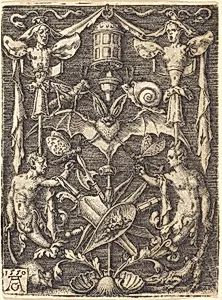
Ornament with Trophy of Arms
Medium
engraving
Classification
Department
CG-E
Museum
National Gallery of Art, Washington, D.C.
Credit
Rosenwald Collection
Accession Number
1943.3.311
Rights
Public Domain
Art Historical Context
**Ornament with Trophy of** is a captivating engraving by Heinrich Aldegrever, a masterful German artist from the Northern Renaissance, created in 1550. Aldegrever, active in Soest, Westphalia, was one of "Little Masters," renowned his intricate small-scale prints that packed monumental detail into compact formats. This work, housed in the National Gallery of Art's Rosenwald Collection, exemplifies his skill in ornamental design, featuring a trophy of arms—a symbolic arrangement of weapons, shields, and helmets evoking martial glory and Renaissance ideals of chivalry. Engraved on a metal plate, the medium allowed Aldegrever to achieve fine lines and rich tonal contrasts through intaglio printing, where ink clings to incised grooves. Such techniques made his prints highly reproducible, serving as pattern books for goldsmiths, armorers, and textile designers across Europe. In the mid-16th century, amid the Reformation and expanding print culture, these ornaments bridged art and craft, disseminating sophisticated motifs inspired by antiquity and contemporaries like Albrecht Dürer. This piece invites visitors to appreciate how Aldegrever transformed everyday utility into high art, reflecting the era's fascination with symmetry, symbolism, and technical virtuosity. A testament to printmaking's revolutionary role, it remains a gem for exploring Renaissance ingenuity.
About the Artist
Heinrich Aldegrever · 1502–1561
Heinrich Aldegrever, born in 1502 in Paderborn, Westphalia, to parents Herman and Katherine Trippenmeker—a family of clog-makers known by the dialect name Trippenmecker—emerged as a multifaceted artist in the German Renaissance. His early training remains undocumented, though he likely apprenticed in a Soest goldsmith's workshop after relocating there around 1525, where he joined the painters' gui...