
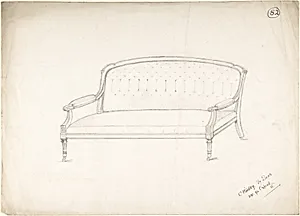
Design for a Loveseat
1884–92
Medium
Graphite
Dimensions
sheet: 10 1/2 x 14 11/16 in. (26.6 x 37.3 cm)
Classification
Drawings|Ornament & Architecture
Department
Drawings and Prints
Museum
Metropolitan Museum of Art, New York, NY
Credit
Harris Brisbane Dick Fund, 1946
Accession Number
46.38.21
Rights
Public Domain
Tags
Art Historical Context
This delicate graphite drawing, titled *Design for a Lovese* by the esteemed British firm Charles Hindley and Sons, to 1884–92, capturing the elegance of late Victorian furniture design. Rendered on a modest sheet measuring 10 1/2 x 14 11/16 inches, it exemplifies the precision of 19th-century ornamental sketches, now housed in the Metropolitan Museum of's Drawings and Prints departmentCharles Hindley and Sons, prominent London cabinetmakers, specialized in upholstered that blended comfort with opulent decoration, reflecting the Aesthetic Movement's influence toward beauty and craftsmanship over mere utility. Loveseats like this one were intimate pieces for parlors, symbolizing domestic refinement during an era of industrial prosperity and expanding middle-class homes. The design likely previewed a piece with curved forms and intricate detailing, essential for manufacturers to visualize production. Graphite's fine lines and subtle shading allowed designers to convey texture, proportion, and embellishments with remarkable clarity, bridging artistry and industry. This surviving example highlights how such drawings preserved innovative ideas, offering us a window into Victorian tastes and the collaborative craft of furniture making.
About the Artist
Charles Hindley and Sons · 1841–1917
**Charles Hindley and Sons: Victorian Masters of Furnishing Design** Charles Hindley and Sons was a premier British cabinet-making and upholstery firm based in London, operating primarily from 134 Oxford Street. Established around 1820 by Charles Hugh Hindley, a furniture maker and upholsterer initially on Berners Street, the firm expanded significantly in 1844 by acquiring the rival establishmen...