
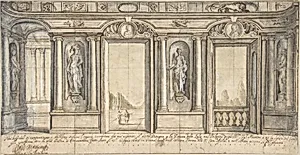
Design for a Painted Wall Decoration for Palazzo Massimo all'Aracoeli (Rome)
1683
Medium
Pen and ink with green and gray wash, highlighted with white gouache
Dimensions
8 5/8 x 16 5/8in. (21.9 x 42.2cm)
Classification
Drawings|Ornament & Architecture
Department
Drawings and Prints
Museum
Metropolitan Museum of Art, New York, NY
Credit
The Elisha Whittelsey Collection, The Elisha Whittelsey Fund, 1954
Accession Number
54.648.3
Rights
Public Domain
Tags
Art Historical Context
This delicate drawing by Basilio Briccio a Roman architect and designer active in the late 17th century, presents a preparatory design for a painted wall decoration in the Palazzo Massimo all'Aracoeli, a historic residence near Rome's Capitoline Hill. Created in 1683, it captures the grandeur of Baroque-era interiors, where elaborate frescoes and trompe-l'œil effects transformed walls into illusionistic extensions of architecture. Briccio's work reflects the opulent decorative traditions of papal Rome, blending architecture with painted ornament to evoke splendor and movement. Executed in pen and ink with green and gray washes, the sheet is enlivened by white gouache highlights that suggest light, shadow, and three-dimensionality—techniques essential for architectural renderings of the period. These washes mimic the frescoes' intended colors and textures, allowing patrons to visualize the final painted scheme on the palace's walls. At 8⅝ × 16⅝ inches, its horizontal format suits a panoramic wall panel, showcasing motifs like scrolling foliage and architectural frames typical of Roman Baroque ornament. Housed in The Metropolitan Museum of Art's Elisha Whittelsey Collection, this design offers a window into the collaborative world of 17th-century Roman patronage, where artists like Briccio bridged drawing and grand-scale decoration. It highlights how such sketches were vital tools for commissioning lavish palazzo interiors that celebrated the city's artistic legacy.