
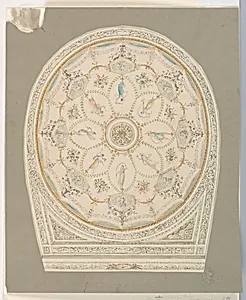
Design for a Theater Ceiling
Classification
theater
Department
Smithsonian Collection
Museum
Smithsonian American Art Museum
Credit
Museum purchase from the Mary Hearn Greims Fund
Accession Number
1940-21-22
Rights
Public Domain
About this artwork
Research in Progress
Art Historical Context
Giuseppe Borsato (1770–1840), a Venetian artist renowned for his architectural decorations, created this *Design for a Theater Ceiling* around 1830. As Italy's theater culture flourished in the early 19th century, opulent interiors became symbols of grandeur, blending architecture with illusionistic painting. Borsato's work reflects this era's emphasis on elaborate ceiling designs, often featuring frescoes, stucco, and trompe-l'œil effects to evoke celestial or mythological scenes, heightening the dramatic experience for audiences. Though the medium remains unidentified amid ongoing research, such designs were typically preparatory drawings or gouaches, guiding craftsmen in crafting immersive theater spaces. Acquired through the Smithsonian American Art Museum's Mary Hearn Greims Fund purchase, this piece highlights cross-cultural exchanges, bringing Italian theatrical artistry into an American collection. It offers a glimpse into the Neoclassical-Romantic transition, where spectacle and technical innovation merged to elevate public entertainment. Visitors will appreciate how Borsato's vision captures the theatrical magic of its time, inviting us to imagine gilded halls alive with performance. (178 words)