
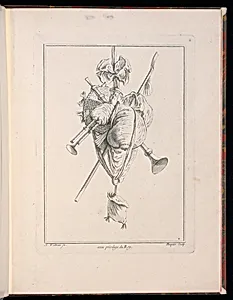
Design for a Trophy
Classification
Department
Smithsonian Collection
Museum
Smithsonian American Art Museum
Credit
Purchased for the Museum by the Advisory Council
Accession Number
1921-6-494-2
Rights
Public Domain
About this artwork
Research in Progress
Art Historical Context
Antoine Watteau, the celebrated French Rococo master (1684–1721), is best known for his enchanting *fêtes galantes*—elegant outdoor scenes of lovers and revelers that defined early 18th-century taste. *Design for a Trophy*, dated around 1735, reflects his influence even after his early death. As a posthumous print from the Smithsonian American Art Museum's collection, it likely reproduces one of Watteau's intricate preparatory drawings, showcasing his skill in ornamental design. Such trophies were popular decorative motifs in Baroque and Rococo interiors, assembling symbolic objects like shields, weapons, or musical instruments to evoke triumph or festivity. Though the exact medium remains under study ("Research in Progress"), its classification as a print highlights the era's reproductive techniques, such as engraving, which disseminated designs to architects, craftsmen, and collectors across Europe. Watteau's fluid lines and playful asymmetry brought a lightness to these traditionally rigid forms, bridging fine art and applied decoration. Purchased for the museum by the Advisory Council, this work underscores Watteau's enduring legacy in shaping opulent, whimsical aesthetics that influenced generations of artists and designers.