
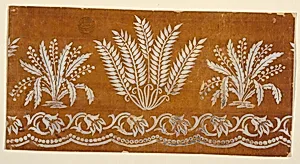
Design for an Embroidered or Woven Horizontal Border of the "Fabrique de St. Ruf"
1805–1815
Classification
Drawing
Department
Smithsonian Collection
Museum
Smithsonian American Art Museum
Credit
Gift of Eleanor and Sarah Hewitt
Accession Number
1914-21-90
Rights
Public Domain
About this artwork
Research in Progress
Art Historical Context
Step into the elegant world of early 19th-century French with this *Design for an Embro or Woven Horizontal Border from the Fabrique de Ruf in Lyon, France, created between 1805 and 1815. Lyon, long celebrated as Europe's silk capital, was home to prestigious manufactories like Saint Ruf, which produced luxurious fabrics for fashion, furnishings, and export. This drawing—likely a preparatory sketch on paper—served as a blueprint for intricate borders destined for embroidery or weaving, capturing the opulent Empire style of Napoleon's era with its neoclassical motifs and refined patterns. As a testament to the artistry behind textile production, the design highlights the meticulous craftsmanship of Lyon's weavers and designers. Horizontal borders like this adorned shawls, dresses, and upholstery, symbolizing wealth and sophistication amid post-Revolutionary France's economic revival. Though the exact medium remains unknown and research continues, its presence in the Smithsonian American Art Museum's collection—gifted by design enthusiasts Eleanor and Sarah Hewitt—underscores the global influence of French textiles on American tastes. This humble drawing invites us to appreciate the unseen labor that transformed sketches into sumptuous silks, bridging art, industry, and everyday luxury. (198 words)